Our Year 8 Introduction to ‘Music in Society’
Have you ever thought about the music that plays in the background of a movie? Or even the music in a video game? How about those catchy tunes from advertisements you like?
The topic for the remainder of Year 8 Music this term is “Music in Society.” For this unit, we have to analyse music from a film or video game. We need to talk about how and what in the music makes us feel a certain way, which instruments play particular parts and the impact of dynamics and tempo.
To introduce us into the thinking mindset needed to breakdown film and video game music, Andrew Pogson, Head of Presentations, Melbourne Symphony Orchestra, joined a Teams meeting last Thursday 26 August to talk to us about elements of film music.
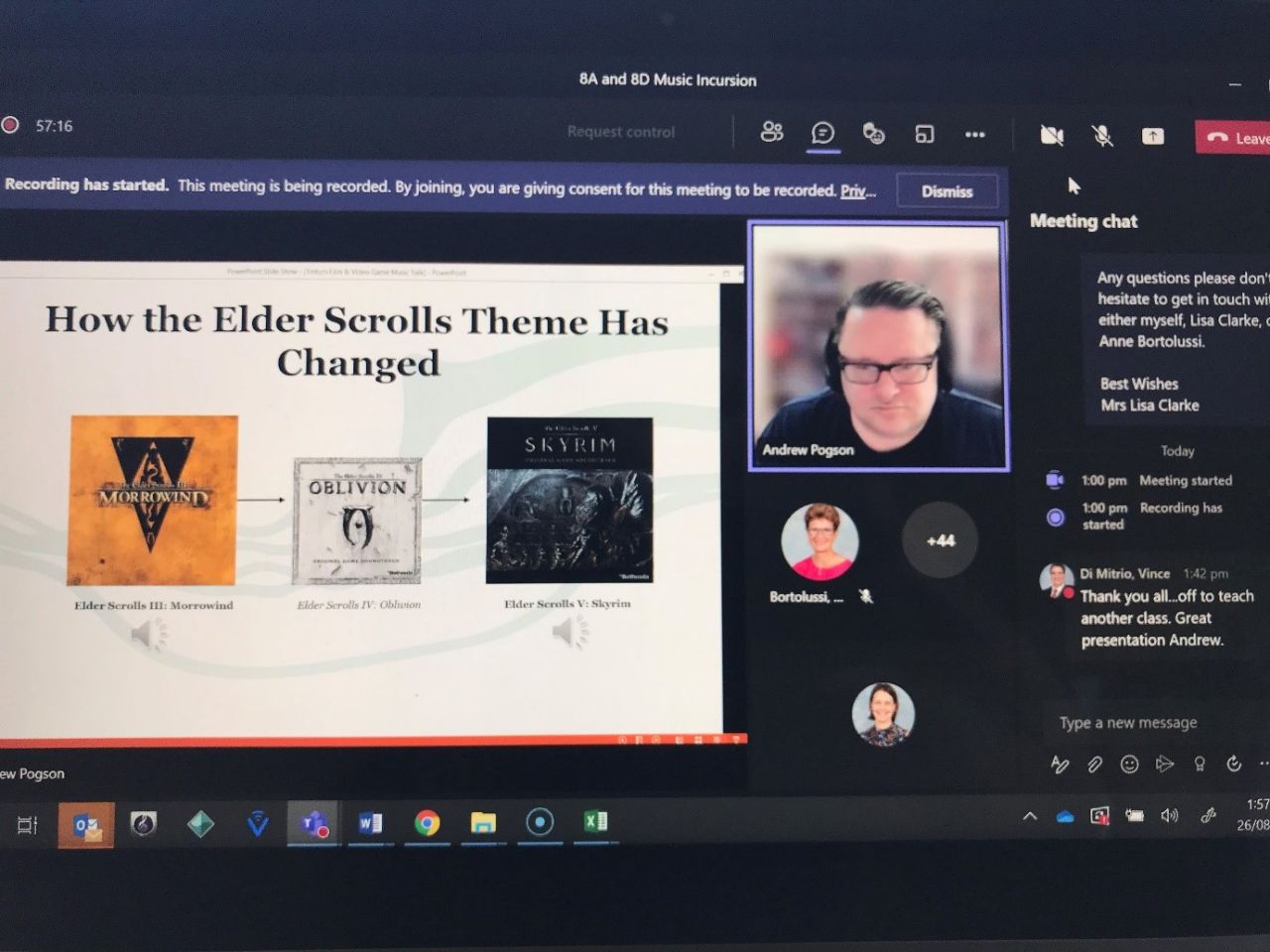
Andrew first introduced us to an analysis ‘toolkit’, which consisted of:
- Tempo: how fast or slow is the piece?
- Harmony/Key: is the piece in a Major or Minor key?
- Instrumentation and Texture: which instruments has the composer chosen to use?
- Dynamics: how loud or soft is the piece? Do the dynamics change?
- Melodic Contour: how smooth or jagged is the melody?
Andrew then introduced us to the composer behind so many of the top box office hits: Harry Potter, Indiana Jones, Jaws, E.T, and even Jurassic Park. He explained that John Williams uses a ‘trick’, called “leitmotif” – ‘a tune or theme associated with a character, which returns with the character on screen. The leitmotif doesn’t have to stay the same and can be changed according to the emotional state of the character or the overall context of the particular scene in the movie.’
Andrew chose Star Wars, also by John Williams, to lead us through an analysis of Luke Skywalker’s Theme (more commonly recognised as the ‘Star Wars’ theme). We learnt that throughout the entire series of Star Wars movies, this leitmotif is used. Nearly every time Luke enters on screen, this theme does too, but it is different depending on the context. However, the leitmotifs associated with each character can also appear when the characters are not on screen. There is one scene in the movie in which Darth Vader is thinking about Princess Leia as he walks to interrogate her, and Leia’s theme is played before she even appears. The effect it had was like warning and created a build up without even saying so, like an Easter egg for an audience member who was listening.
We listened to the main ‘variation’ of the theme and applied the toolkit, looking at dynamics, instruments and contour. Andrew explained how, on the written music, we can see the melody goes up in ‘leaps,’ and comes back down all through the melody. These leaps up and notes coming down again, symbolises Luke’s characteristics in the movies. He is the hero, mostly filled with confidence, but at times, he second guesses himself, doubts himself. This is part of his character; therefore, it is a part of his theme. I found this really fascinating, as it shows that the composers don’t just want the music to sound well overall, but subtly reflect the characters in their music.
We also listened to a different version of the theme, when Luke was flying towards the Death Star. It was different, but still clearly the same melody. Listening to the first round of the melody, it starts with a triumphant fanfare, implying that Luke was gaining confidence. The second time, I could definitely feel the sudden pressure and stress Luke was feeling. This ‘tension’ in this scene is created by a piccolo above the trumpets’ line. Also, the last few notes sound ‘off’, adding to the action.
This is the essence of the leitmotif system. The same melody is used to symbolise and bond with the characters, but changes in context to what they are going through. The whole incursion was very insightful. I know what to look for when analysing any music now. And I definitely know that next time I go to a movie, I will be switched on to all the different things composers do to make the magic work.
Arya Yogesh Kumar 8D
Student musos doing a great job!
All of the instrumental teachers are thrilled that Instrumental and Voice students and students of Speech and Drama are turning up regularly to their online lessons and maintaining their levels of interest and energy in their assigned tasks and independent explorations of music and text. Many are preparing for upcoming AMEB or Trinity examinations in Term 4, so maintaining consistent practice routines will stand all of these students in good stead, moving forward towards these assessments. Well done, musos!
Percussion Concert postponed
Our Percussion Concert scheduled for Monday 6 September has been postponed until Term 4, on a date yet to be determined. All drummers and percussionists should keep up their great practice routines in order to be ready to play their selected piece next term!